
Stock markets are expected to see volatility this week due to potential risk from Omicron variant and monthly derivatives expiry, say analysts. "Markets will continue to see volatility and whipsaw-like movements as they respond to Omicron-related development and the monthly expiry," said Yesha Shah, head of equity research, Samco Securities. Ajit Mishra, VP - Research, Religare Broking Ltd said, "Markets are closely eyeing the COVID situation and any positive news could only help the index to make any sustainable up move else volatility will continue."

10 non-bank and non-finance stocks from the BSE500 Index universe that offer an optimal blend of low valuation, reasonably robust revenue and earnings growth in recent quarters, a strong balance sheet, and most importantly, positive cash flow from their operations.

Companies don't have to be in the field to nudge people to return money they owe lenders.

Amid a shift in mobility trends and people increasingly opting for less polluting energy sources, sales of compressed natural gas (CNG) vehicles increased more than 82 per cent in the past five years. A total of 729,902 CNG vehicles were sold in 2022-23 against 400,825 in 2017-18, according to VAHAN Dashboard. Though the increase in sales of CNG-powered vehicles has been significant, their share in overall vehicle sales remains minuscule as is the case with EVs.

A ramp-up in COVID-19 vaccination, healthy advance estimates of kharif (summer) crop and faster government spending were the factors which led to the revision, the agency said in a statement. It can be noted that after the 7.3 per cent contraction in 2020-21, there were expectations of a higher growth number in 2021-22.

Hospitals to recover from sluggish Q3; diagnostics' growth rate at pre-Covid levels.

Asian Paints was the top loser in the Sensex pack, tanking around 5 per cent, followed by Reliance Industries, Infosys, Tata Steel, TCS and Dr Reddy's.

'Periods of high volatility are usually bad for mid-caps and this is something that has to be kept in mind.' 'Focus on quality is of paramount importance.'

'We suggest investors with suitable risk appetite to consider allocating 40-50 per cent in large-caps, 25-30 per cent of funds in quality mid and small-caps and the rest in debt and high yield products.'
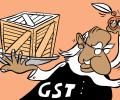
It is now becoming increasingly clear that rising imports have played a significant role in sustaining the buoyancy in revenues from GST, notes A K Bhattacharya.

The Indian office real estate market, which had recovered significantly in early 2022, began to slow down in the latter half due to macroeconomic problems in the developed world. Rental yields are likely to be stable at best in FY24.

He also said that terrorists are constantly finding new ways to carry out violence, radicalise youth and raise financial resources and the darknet is being used by terrorists to spread radical content and conceal their identities.
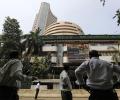
Bajaj Finserv was the top gainer in the Sensex pack, rallying nearly 7 per cent, followed by Bajaj Finance, Axis Bank, Reliance Industries and IndusInd Bank.

Reliance Industries was the top gainer in the Sensex pack, soaring over 4 per cent, followed by Titan, Tata Steel, Bajaj Auto, Maruti and Dr Reddy's. Nifty advanced 89.45 points to its all-time closing peak of 17,323.60.

Initial public offerings (IPOs) have attracted droves of retail investors to the stock market in CY22. But these applicants have lost money on 40 per cent of the fresh issues this year - a trend that may impact sentiment towards maiden share sales during the remaining part of the year. Of the 14 companies that have listed this year, five have closed below their issue price.

India's largest listed pharmaceutical (pharma) company - Sun Pharmaceutical Industries (Sun Pharma) - is expected to maintain its outperformance vis--vis the sector's, as its multiple bets on specialty products, improving product mix, recent acquisitions, and branded business are finding favour with brokerages. While it has gained 7 per cent over the past year, the Nifty Pharma Index is down 13.6 per cent. Its outperformance over two years has been fairly evident, with the market leader gaining 66 per cent to Nifty Pharma's minus 1.4 per cent.

After navigating the turbulent pandemic waves, the recovering Indian economy is now sailing through unchartered waters of rising coronavirus cases, spiralling commodity prices and spiking inflation though the lighthouse of sustainable growth remains visible. As 2022 begins, a raft of developments, ranging from Budgetary announcements to continuation of stimulus measures to monetary policy, will set the tone for the domestic economy, which is projected to grow more than 9 per cent in the current fiscal ending March 2022. The country's continuing massive vaccination drive and 'precaution' doses starting for select categories of people this month will provide a firewall against any steep spike in coronavirus cases amid the emergence of the Omicron variant.

Chinese foreign ministry spokesperson Mao Ning said China believes that state-to-state interactions should be in line with the trend of the time which is peace and development rather than exclusivity.

Credit card spends touched an all-time high of Rs 1.16 trillion in July, registering a growth of 6.5 per cent on a month-on-month basis and 54 per cent year-on-year, latest data put out by the Reserve Bank of India revealed. Spends have topped the Rs 1 trillion level for five consecutive months now. Industry participants are expecting further tailwinds in credit card spends with the onset of the festive season, where spends typically remain at an elevated level.

Putting forward the government's view on the high level of fiscal deficit, Arvind Virmani, chief economic adviser in the finance ministry, claims the 6 per cent deficit is reversible.
Mixed earnings and not so encouraging macroeconomic data dented sentiment, Ajit Mishra, VP - Research, Religare Broking Ltd said. In twin blows to Indian economic revival, higher food prices drove retail inflation to a five-month high of 7.4 per cent, while factory output fell for the first time in 18 months. The second consecutive month of rise in consumer price index (CPI)-based inflation will add to the pressure on the Reserve Bank of India (RBI) to again raise interest rates to tame high prices. In the broader market, BSE Midcap declined 0.73 per cent while smallcap dropped 0.45 per cent.

ICICI Bank was the top gainer in the Sensex pack, soaring nearly 11 per cent, followed by Axis Bank, Dr Reddy's, SBI, M&M and Tech Mahindra. NSE Nifty advanced 10.50 points to 18,125.40.

In recent years, the twin demands of both religion and defence have been added to the development argument to sweep aside environmental and terrain considerations while undertaking infrastructure development in the Himalayan zone, points out former foreign secretary Shyam Saran.

'I think it's a very healthy trend. It's an embarrassment of riches.'

In cross-currency trades, the rupee firmed up further against the pound sterling

'I hope the trend is sustainable and that economic activity accelerates going forward.'

Many IEDs explode even when the troops are on foot and their trigger mechanism gets activated just due to the pressure of the feet. These incidents have injured more than 100 personnel over the last two years, the officer said.

'Today, there is no easy money to be made after the run-up in equities.'

'India will want a lot of help from the US, but it's not going to want US troops.'

'Marginal rates will definitely affect the consumer's decision in entering a new transaction, but in reality, they don't affect much because banks/financial institutions have come up with step-up EMIs: 50% of home loans which exceed 15 years in India are prepaid, within 7-8 years.' 'This doesn't happen anywhere in the world.'

The second quarter of FY22 continued to show double digit growth for the top four IT services providers, with every vertical and geography growing well, even though the total contract value (TCV) looked soft for all the players. The trend was first evident in Accenture's Q4 numbers, which saw its TCV in outsourcing deals softer. A soft TCV does not mean that growth is declining, but it does point to the trend of few and scarcer mega deals.

Don't exit from growth-style funds as they may benefit next from a shift in investor preference.

Evicted Bigg Boss 15 contestant and actor Donal Bisht gets candid about her love for fashion, food and more.

India's manufacturing sector activities witnessed faster growth in April amid quicker increases in production as well as factory orders, and renewed expansion in international sales, a monthly survey said on Monday. The seasonally adjusted S&P Global India Manufacturing Purchasing Managers' Index (PMI) rose from 54.0 in March to 54.7 in April, as a retreat of COVID-19 restrictions continued to support demand. The April PMI data pointed to an improvement in overall operating conditions for the tenth straight month. In PMI parlance, a print above 50 means expansion, while a score below 50 denotes contraction.

'You may see some movement indicating a simpler tax regime with less exemptions but with fewer tax rates making life simpler for taxpayers.'

What to expect at the Fashion Design Council of India x Lakme Fashion Week

The week ended October 17 was remarkable as it saw a fall in the unemployment rate. We have not seen such a level in any monthly estimate of the employment rate since March 2020, Mahesh Vyas points out.

For large numbers of employees in the government system, the month-end salary cheque is no longer guaranteed. So the days of the government and State-owned enterprises wanting to be ideal employers are over, observes T N Ninan.

What inspires Designer Amit Aggarwal and why is his flagship Mumbai store so special?

M&M was the top gainer in the Sensex pack, zooming over 5 per cent, followed by PowerGrid, ITC, L&T, Tech Mahindra, Titan and Tata Steel. Nifty rallied 169.80 points to 18,161.75.
